Supercharge your preparation with our intensive, result-focused Economics Crash Course for Class 11 & 12 Commerce students. Mentored by seasoned educator Payal Khanna, this high-speed revision program consolidates complex theories, decodes high-weightage numericals, and perfects your board answer-writing technique in record time.
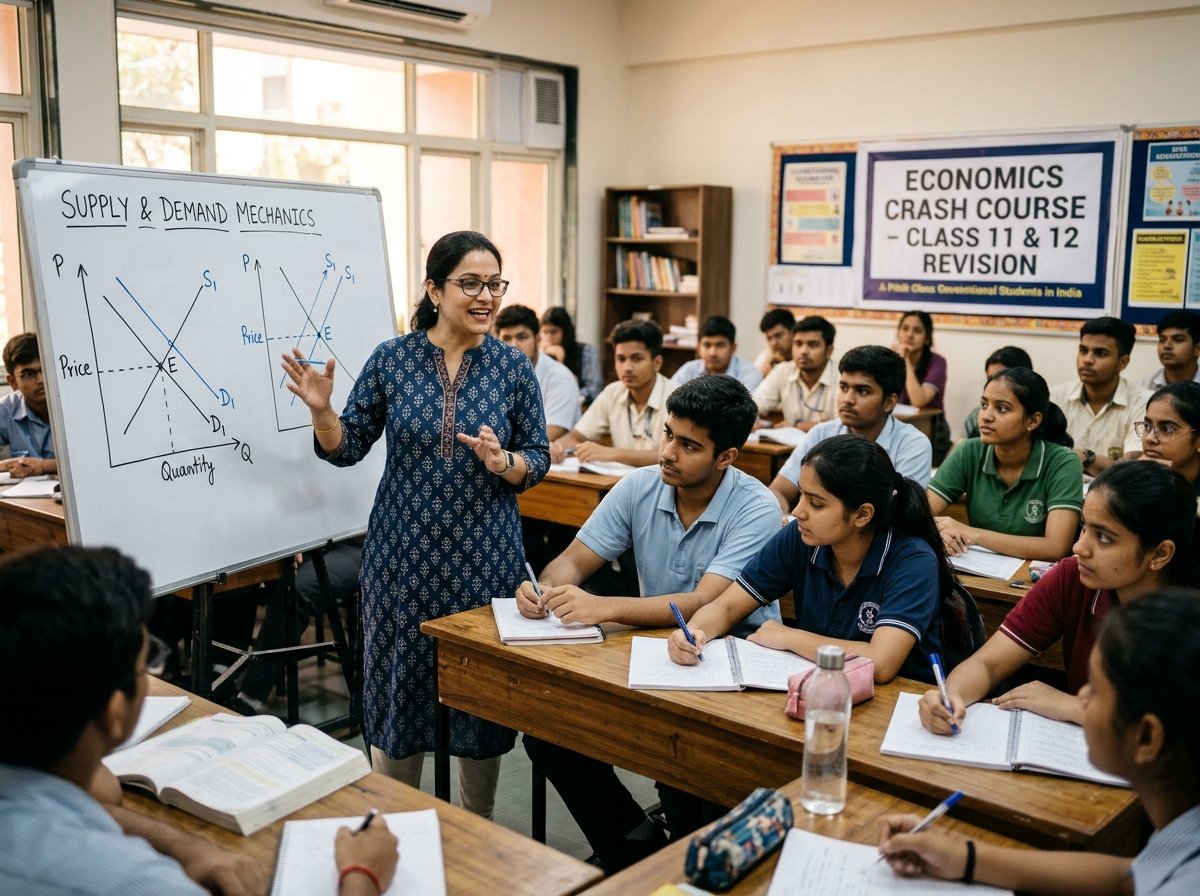
Targeted coaching for CBSE & ICSE Class 11 and 12 students. Rapid coverage of high-yield chapters, past 10-year questions, and personalized doubt resolution.
Days Fast-Track Track
High-Yield Numericals Covered
Simulated Board Mock Exams
Personal Doubt Mentorship
When time is limited before pre-boards or final board exams, random revision causes burnout. Our 4-pillar fast-track methodology ensures maximum retention with minimum stress:
Condense entire chapters into crisp, high-yield frameworks. Zero fluff—focus exclusively on scoring concepts, laws, assumptions, and critical definitions.
Step-by-step algorithms to solve tricky National Income, Multiplier, Elasticity of Demand, and Statistical dispersion calculations with zero calculation errors.
Solve the most repetitive board exam questions, competency-based case studies, and tricky Assertion-Reasoning questions with model examiner answers.
Learn how board examiners grade papers. Format 3, 4, and 6-mark answers with underlined headings, precise diagrams, and neat conclusions to secure full marks.
The Ecoment Economics Crash Course is engineered specifically for students who want to bridge learning gaps, overcome exam anxiety, and elevate their marks right before the board examinations.
Whether you are starting late, seeking a thorough revision of high-weightage chapters, or aiming to push your current score from 75% to 95%+, our structured sprint modules give you the exact tools needed for top-tier performance.
A streamlined fast-track curriculum covering both Class 11 and Class 12 high-scoring board units with maximum numerical and diagram practice:
Focused rapid revision of consumer behaviour, production cost curves, market forms, and core quantitative statistical tools.
Law of Diminishing Marginal Utility, Indifference Curve analysis, budget lines, consumer equilibrium conditions, and foolproof percentage numericals on Price Elasticity of Demand.
Consumer's Equilibrium Indifference Curves Law of Demand Elasticity NumericalsShort run and long run production functions, Law of Variable Proportions, interrelation between Total, Average & Marginal cost curves, and MR-MC producer equilibrium condition.
Variable Proportions Cost Curves (AC, AVC, MC) Revenue Analysis Producer's EquilibriumPerfect competition features, equilibrium price determination, simultaneous shifts in demand and supply curves, and real-world price ceiling & floor applications.
Perfect Competition Equilibrium Shifts Price Ceiling Price FloorCalculation mastery for Mean, Median, Mode (continuous series), Standard Deviation, Coefficient of Variation, and drawing error-free Histograms and Ogives.
Mean, Median, Mode Standard Deviation Ogives & Histograms Coefficient of VariationMaster high-weightage National Income numericals, Keynesian multiplier models, Monetary policy instruments, and Indian economic development timelines.
100+ numerical problem drills covering Value-Added, Income, and Expenditure methods, with tricky adjustments for NFIA, intermediate consumption, and operating surplus.
Value Added Method Income Method Expenditure Method Real vs Nominal GDPCredit creation by commercial banks, Money multiplier, RBI quantitative tools (Repo, Reverse Repo, CRR, SLR), and Government Budget deficit calculations.
Credit Creation Money Multiplier Monetary Policy Fiscal & Primary DeficitsAggregate demand & supply components, Two-sector Keynesian equilibrium, Investment Multiplier mechanism, Deficient/Excess demand remedies, and Balance of Payments accounts.
Aggregate Demand Investment Multiplier Inflationary Gap BoP Current & CapitalHigh-yield revision of 1950-1990 policies, 1991 LPG reforms, Human capital formation, Rural development, and comparative development experiences of India, Pakistan, and China.
1991 LPG Policy Reforms Human Capital Rural Credit India vs China vs PakTargeted practice on high-frequency questions extracted directly from CBSE and ICSE past board examinations:
Real-time mock exams conducted under strict board exam hall conditions with detailed examiner evaluation:
Our fast-track program is tailored for diverse student requirements right before critical exams:
Students who couldn't cover the full syllabus during the academic year and need a structured, high-speed completion path.
Students feeling nervous about National Income adjustments, demand elasticity percentages, and macroeconomic multiplier graphs.
Scorers stuck in the 70%–80% bracket seeking exam-hall tricks, answer formatting, and examiner-focused presentation to break into the 95%+ tier.
Commerce students gearing up for school pre-boards, board mock exams, and CBSE/ICSE final tests wanting rapid revision with mock papers.
Draft complete 6-mark answers with standard NCERT definitions, structured headings, and fully labeled economic curves.
Accurately solve Value-Added, Income, and Expenditure numericals without getting tricked by indirect taxes, subsidies, or factor payments.
Master time distribution per section so you have ample time to review your answers and prevent careless errors.
Take away ready-to-revise formula sheets, IED timeline charts, and flash summaries for last-minute morning revision.
Chief Lecturer & Founder, Ecoment
In a fast-track crash course, the mentor's clarity and exam insight make all the difference. Under the direct mentorship of Payal Khanna, you get individual attention that identifies your specific weak spots and fixes them immediately.
Our Economics Crash Course typically runs for 30 to 45 days, with high-frequency classes (daily or alternate days depending on the batch). Weekend accelerated batches and flexible timings are also available for students managing multiple subjects.
Yes! We have separate, dedicated crash course tracks for Class 11 (Microeconomics & Statistics) and Class 12 (Macroeconomics & Indian Economic Development). Each track is strictly tailored to the respective board syllabus.
Yes! Offline sessions are conducted at our coaching center at Flat No. 35-C Highland Park Terraces, Zirakpur. Students across Tricity (Chandigarh, Mohali, Panchkula) or anywhere in India can join our live, interactive online classes with digital whiteboard and session notes.
We employ a proven step-by-step algorithm that breaks down complex Value Added, Income, and Expenditure problems. Students practice 100+ curated numericals with all typical board exam traps (NFIA adjustments, operating surplus, subsidies) so solving becomes second nature.
Yes! The course includes at least 5 full-length 80-mark mock examinations simulating exact board conditions. Each paper receives personal 1:1 evaluation by Payal Khanna with actionable feedback on diagram neatness, heading structures, and timing.
Absolutely. We encourage students and parents to attend a free trial session or consult with Payal Khanna directly to evaluate their current preparation and experience our teaching methodology firsthand.
Have questions about batch timings or want to book a free trial session? Contact us today.
+91 821 929 8496
Get structured online/offline classes with 1:1 doubt solving. Reply Hi to begin your learning journy